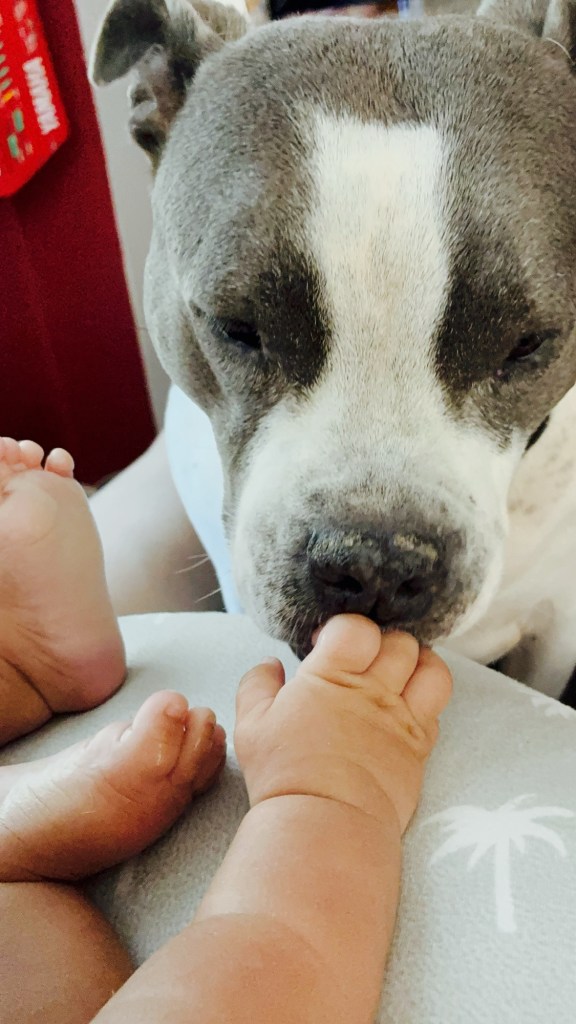
During late-night feedings with my daughter, I kept noticing something simple but powerful: a gentle head rub puts her to sleep. My pets do the same melt-into-the-floor thing with head scratches. And let’s be honest, the shampoo at the salon is the real reason most of us book an appointment, right?
These moments feel magical, but the reason is actually biological.
We aren’t just drawn to the pampering, we’re responding to what our nervous system recognizes as safety.
What Head Rubbing Actually Does
When the scalp is touched gently and rhythmically, pressure receptors activate and send signals to the brain. The parasympathetic nervous system switches on and releases chemicals that help us to relax, such as oxytocin, serotonin, and endorphins.
In effect, a head rub tells the body: “You’re safe. You can relax now.”
It’s a primal cue that babies respond to, animals crave, and adults lean into because the touch is intimate and signals trust, comfort, and care.
A tiny action → a big physiological shift
What This Means for Leadership, Design, and MADE
At MADE (Mission-Aligned Design Excellence), we focus on creating experiences that work with human behavior. People show up differently when they feel safe, seen, and supported.
Just like a head rub, effective design uses signals, not force.
- Clear agendas reduce anxiety.
- Predictable routines build trust.
- Pauses and pacing prevent overload.
- Transparent expectations create emotional grounding.
These aren’t logistical moves, they are actually nervous system moves.
Design isn’t only strategic.
Design is biological!
Small touchpoints, when aligned with what humans actually need, create massive impact.
What Human-Centered Design Really Is
Human-centered design starts with people: their needs, emotions, abilities, and lived experiences. It asks one essential question:
“What does this feel like for the person experiencing it?”
Rather than optimizing only for efficiency, it prioritizes clarity, accessibility, psychological safety, and connection. When people can understand, navigate, and trust a process, everything else—learning, collaboration, engagement—gets easier.
A head rub calms us because it aligns with how our nervous system understands safety.
Human-centered design operates the same way.
Small, intentional choices—simpler instructions, predictable structures, calmer environments—can shift how people feel, behave, and participate. These design choices become the organizational version of a head rub:
“You’re safe here. You can show up fully.”
How to Start Applying This Mindset Today
Start small!
You don’t need a full redesign to think human-first.
Start by noticing:
- Where might people feel confused or overwhelmed?
- What could be made simpler, clearer, or more predictable?
- What small touchpoint could make this experience feel calmer or more connected?
Then try just one immediate action:
- clarify an expectation
- simplify a form that
- add a grounding opener to a meeting
- adjust a workflow with the user’s emotional experience in mind
Human-centered design begins with awareness. Everything else builds from there.
The MADE Method Applied
Still not sure where to start? Use the MADE pillars to assess any experience, whether you’re supporting staff, clients, or community members:
- Mission: What emotional state do we want people to be in?
- Alignment: Are we designing for psychological safety or just efficiency?
- Design: What is the simplest touchpoint that could shift the experience?
- Excellence: What does science tell us about how humans process connection and how can we apply that thinking?
Small touchpoints + scientific evidence = meaningful, lasting impact.
Just like a head rub calms us without explanation, a well-aligned experience supports people without needing justification.
Closing Reflection
You don’t need grand gestures to build trust, alignment, or momentum.
You just need the right touchpoint.
Ask yourself:
💬 What is the “head rub moment” you could build into your next meeting, workshop, onboarding, or program?
That small shift might create the biggest transformation.
I see you,
Jenn Babcock
Founder, MADE Consulting
Mission-Aligned Design Excellence

 MADE consulting