We often use the phrase “stuck in the hamster wheel” to describe life — going in circles, working hard, and not feeling like we’re moving forward. But the more I think about it, the more I realize this phrase applies to our thinking just as much as our daily routines.
Sometimes our ideas run in circles.
Sometimes our creativity runs in circles.
Sometimes our understanding runs in circles.
We keep circling the same thoughts, using the same language, approaching problems in familiar ways, and wondering why nothing new is emerging. And the answer is often simple: we’re still in the wheel.
The way forward is not always more effort.
Sometimes the way forward is new perspective.
Language: The Starting Point of Creativity
Language gives us a powerful starting point for understanding and creativity. It helps us communicate ideas, imagine possibilities, and build shared meaning with others. Without language, collaboration and innovation would be incredibly difficult.
But language also quietly shapes how we interpret the world.
When we hear a phrase or an idea, our brains tend to fill in the gaps with what we already know. We rely on familiar structures, familiar systems, and familiar mental images. This isn’t a flaw, it’s efficiency. Our minds are designed to make quick sense of information.
The challenge is that efficiency can sometimes keep us inside predictable loops. We interpret ideas through existing patterns instead of exploring what else might be possible.
And sometimes, the most creative insights come from stepping outside those patterns entirely.
The Hamster Schoolbus
Recently, I saw a simple example that captured this idea perfectly.
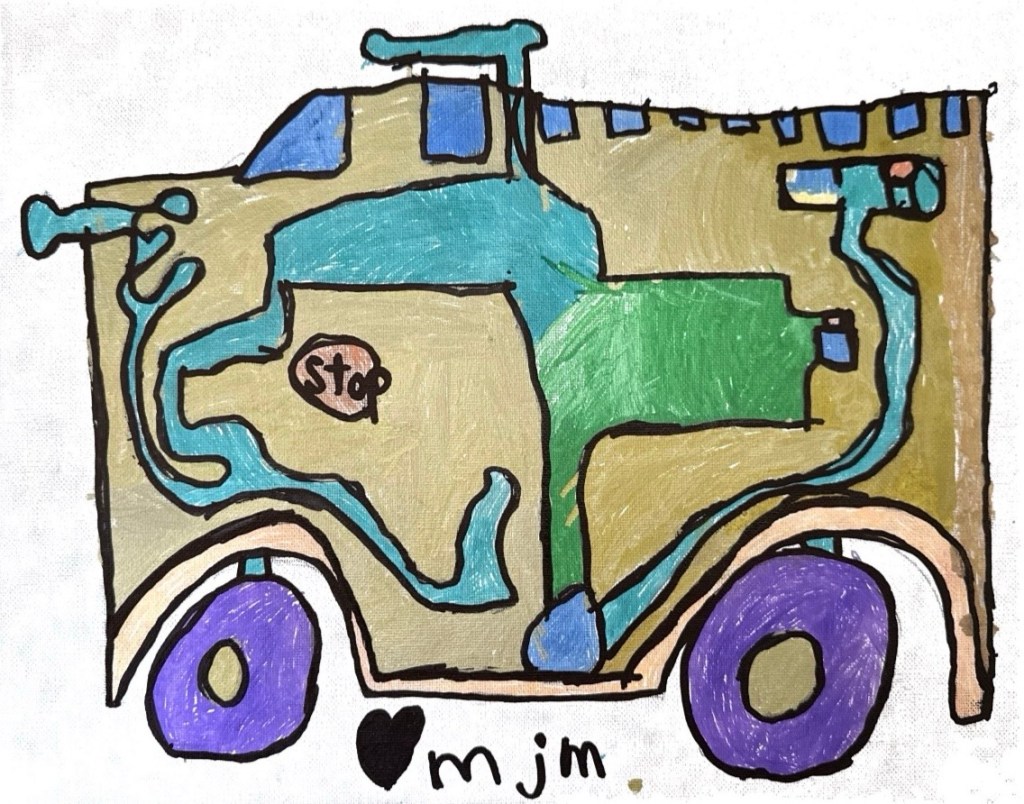
My nephew wanted to paint a “Hamster Schoolbus.”
Most people, when hearing that phrase, would likely imagine something straightforward: hamsters sitting on a yellow school bus, hamsters driving a bus, or maybe a creatively colored human-style bus with hamsters inside. The assumption is natural — take a familiar human object and add hamsters.
But that’s not what happened.
Instead, he designed a schoolbus FOR hamsters.
The bus had tubes for movement, exercise wheels, and spaces built around how hamsters actually live and move. It wasn’t a human bus with hamsters placed inside it. It was a system designed specifically for hamster behavior and hamster needs.
That shift is subtle, but powerful.
The idea moved from placing hamsters into a human-centered design to designing a system around the hamster itself.
That’s divergence!
That’s depth!
That’s creativity rooted in understanding!
The Difference Between Loops and Expansion
Many of us might have drawn hamsters on a bus because we naturally follow familiar patterns. We default to what we know, what we’ve seen before, and what feels normal. In a way, we stay inside the hamster wheel of language and expectation.
We circle the same interpretations.
We repeat the same assumptions.
We stay within comfortable mental structures.
But when new perspective enters the picture, something changes. We begin to see differently. We begin to ask different questions. We begin to imagine new possibilities.
We step off the wheel.
Our thinking expands, not because we tried harder, but because we understood differently.
Creativity often doesn’t come from pushing forward in the same direction. It comes from shifting perspective and designing from a deeper understanding of the subject.
How Humans Get Off the Wheel
Humans expand understanding through experience, not just language.
We learn by seeing, touching, building, observing, listening, experimenting, and interacting with the world around us. We gain insight through lived experiences, conversations, mistakes, exploration, and curiosity. We learn by trying something one way and then trying it another way.
Each new experience adds context.
Each new perspective reshapes understanding.
Each new way of learning opens new pathways for creativity.
This is why multi-sensory learning, diverse perspectives, and real-world experiences matter so much. They give us the context needed to move beyond repetitive thinking and into deeper understanding.
Language introduces the idea, but experience expands it!
Where AI Fits Into This
Artificial intelligence operates primarily through language and patterns. It learns from human-created knowledge, written information, images, and structured data, and it uses those patterns to generate responses, ideas, and connections.
This makes AI incredibly powerful.
It can organize information quickly, generate creative variations, connect ideas across disciplines, and support human thinking in ways that would take much longer on our own. It can help us explore concepts, refine language, and push ideas further.
But AI does not have lived experience.
When humans interact with AI, something interesting happens.
It does not observe the world independently or interact with environments in the way humans do. It does not build understanding through sensory experience or personal perspective. Instead, it responds to the information and context provided to it.
In many ways, AI moves efficiently within the language and patterns it has learned but also misses key moments of depth.
The Role of Human Perspective
This is where human perspective becomes essential.
Humans introduce lived experience, emotion, curiosity, and context. Humans ask unexpected questions, challenge assumptions, and bring new ways of seeing the world. Humans notice things that don’t fit the pattern and explore them further.
Humans introduce new perspectives and new ideas. AI expands and organizes those ideas. Humans reflect and refine them. AI expands again.
The process becomes collaborative.
Not human alone.
Not AI alone.
But a shared expansion of understanding.
AI can move quickly within patterns of language, but humans introduce the divergence that pushes those patterns into new territory.
The Depth of Divergence
The depth of divergence doesn’t come from language alone.
It comes from understanding.
From perspective.
From experience.
From curiosity.
From seeing the world in ways that go beyond familiar patterns.
Sometimes we are all stuck in the hamster wheel of thinking, circling the same ideas and expecting different outcomes. Sometimes the only way forward is a new perspective, a new experience, or a new way of seeing the problem in front of us.
And sometimes creativity looks like a hamster schoolbus — a simple idea reimagined through deeper understanding of the subject itself.
That’s the depth of divergence.
Not just thinking differently.
But understanding differently.
Let me hear your thoughts in the comments below.
- How do you picture a “hamster school-bus”?
- What would your hamster school-bus look like?
- What’s the hamster wheel you’ve been stuck in? Let’s work together to help you break free from that wheel and move towards growth and expansion!
- How many follow-up prompts do you provide to AI if you continue a conversation beyond your initial prompt?
- What questions do you still have?
- What else does this make you think of?

 MADE consulting